
 Call (909) 627-0988
Dental Implants
We accept all PPO and Dentical/Medi-cal insurances
At Chino Aesthetic Dental, Dr. Joshi carefully evaluates every patient’s situation to see if dental implants are right for them. She works closely with you to find the best solution for keeping your smile healthy and intact.
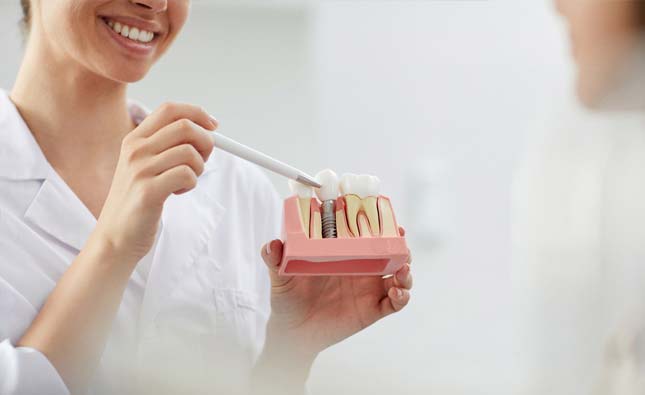
What Are Dental Implants?
Benefits of Dental Implants
Natural Look and Feel
Prevent Bone Resorption
Denture Retention
Preserve Surrounding Teeth
Are Dental Implants Right for Me?
What Is the Process Like?
While dental implants require several visits to the dentist, the entire process is still quite straightforward. Once it is determined you have enough bone mass to support dental implants, you can start with the implant itself. This is inserted into the gums, and then you wait for your jawbone to naturally fuse to the insert. This ensures your crown will have a fully stable base to attach to.
Schedule Your Appointment
Looking for dental implants in Chino, Chino Hills, Upland, Pomona, Claremont, Corona, Norco, Ontario, Diamond Bar, Rancho Cucamonga, Riverside or the Inland Empire? For more information please call our office to schedule your consultation.
Easy Payment Options
Frequently Asked Questions
The price of dental implants ranges between $3000 and $6000, depending on the location of the tooth, the complexity of the case, and the materials used. This price includes exams, scans, the surgery, post-procedure care, and the crown. If you require additional procedures, such as bone grafting or tooth extractions, you will need to pay for them separately.
A dental implant (a metal screw-like post inserted directly into the jawbone) lasts for decades or even a lifetime, provided that your oral health is good. A dental crown that is attached to an implant typically lasts 10 to 15 years.
Dental implants are considered a superior method of restoration compared to dentures and bridges, as they provide more comfort, stability, biting force, and longevity. Additionally, dental implants prevent bone resorption (jawbone density loss) that occurs when you are missing your natural teeth. However, implants might not be an ideal solution for some patients. For example, implants are risky or not recommended for patients who have severe gum disease, autoimmune conditions, cancer, or uncontrolled diabetes. In such cases, dentures or bridges are preferred to dental implants.
The entire process of getting functional dental implants typically takes between 4 and 8 months, depending on your oral and overall health and how quickly your body heals after surgery. The initial surgery might take up to two hours. Then your implant will heal and fuse with the jawbone during the next 4 to 8 months. After the implant is fully healed and stable, the crown will be placed. If you require additional procedures, such as tooth extractions or bone grafting, the total time is likely to increase by 4 to 6 months.
Provided that your oral and general health are good and the procedure is performed responsibly, the success rate of dental implants is high, reaching 90% to 98%. Such factors as smoking and alcohol intake during the healing process or gum disease typically pose risks to implant osseointegration.
Dental implant surgery is not painful, as it is performed under local anesthesia that completely numbs the surgical site. Additionally, in complex cases, your dentist might opt for sedation to make the procedure as comfortable and safe as possible for you. However, you are likely to experience soreness, pain, and swelling during the first 10 to 14 days after the procedure until the surgery site sufficiently heals.
Recovery after dental implant surgery can be roughly divided into two stages. The initial recovery takes 10 to 14 days, or up to a month in some cases. During this time, you will experience soreness and swelling, which will gradually subside as healing progresses. Once the initial stage is complete, your new implant will fuse with the jawbone, which is the second stage and takes 4 to 8 months. After this process, called osseointegration, is complete, your implant will become stable, and a crown will be placed.
Dental implants consist of three main parts: a screw-like post (the implant itself), an abutment (which connects the implant to a crown), and a dental crown. The post and the abutment are typically made of titanium, a biocompatible and durable material. The crown can be made of porcelain, zirconia, or porcelain-fused-to-metal.